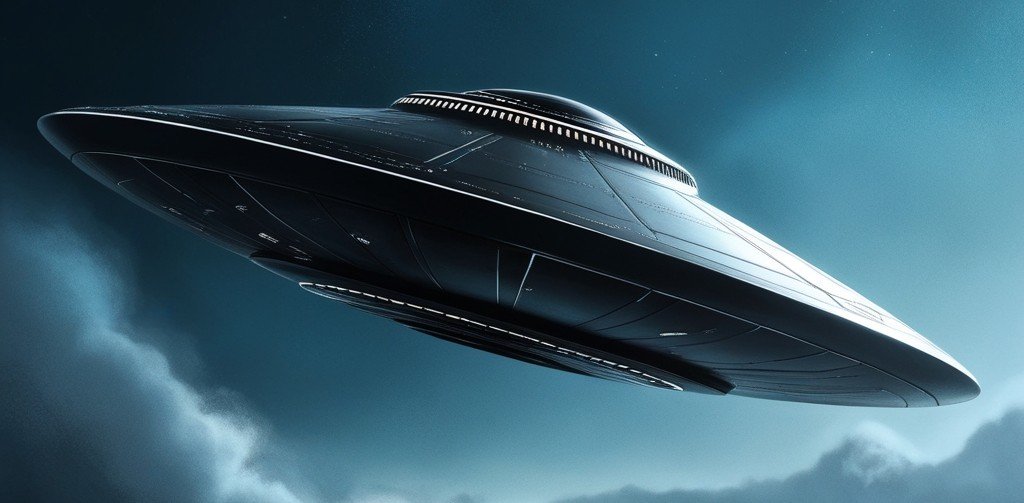
The UFO Experience
Describing the Event
It all started when my father called out to me and pointed toward the Victoria Shipyard gantry cranes.
It took me a few seconds to pinpoint what he was looking at. When I finally saw it, my eyes locked onto a dark, black object. It moved slowly, pausing briefly over the Esquimalt Naval Base situated along the peninsula of West Bay, Victoria.
We sat there, completely mesmerized.
The object drifted out over the open water past the Brother Islands, hovering again for about ten seconds. Then, without warning, it accelerated directly toward us on a sweeping upward curve, shooting out of the atmosphere in a matter of seconds.
No sonic boom.
No rush of displacement.
Not even a light breeze. Just silence.
And then, it was gone. All we were left with was a story that—at the time—no one would ever believe without proof.
Perspective & Size
In the months that followed, this shared experience completely occupied our minds. We constantly debated and analyzed what we had seen.
At first, we were divided on the actual scale of the craft. My initial estimate was massive—roughly 150 to 200 feet in diameter. My father, however, was skeptical. When he asked how big I thought it was as it flew directly over us, I had to pause.
Upon reflection, it seemed much smaller up close. At the time, I rationalized this by assuming it must have been much higher in the sky against the vast blue backdrop.
However, my father had engineering training and was an avid amateur astronomer. He was well-versed in how easily our eyes are deceived when looking up at a cloudless sky. He explained that human perception naturally exaggerates the size of unfamiliar objects—especially things we cannot explain. Because we have no reference point to ground our visual memory, our brains tend to scale up. In hindsight, I could have easily overestimated its size by 10 to 15 times.
Distance was another variable. My father’s observatory was located in the small community of Happy Valley on Klahanie Drive. Our vantage point was roughly 3.5 to 4 miles from the naval base peninsula at the entrance of the Esquimalt Lagoon. If the craft appeared smaller when directly overhead, it may have simply been a smaller craft flying closer to us, rather than a giant object far away.
The Speed of Light Dilemma
Once we revised our estimate of the craft’s size to around 50 to 100 feet (about 30 meters) in diameter, our discussion shifted: How did it get here?
As an astronomer, my father could easily recite stellar distances. The stars nearest to Earth range from 4 to 100 light-years away. At the speed of light—roughly 186,000 miles per second—a journey from our nearest neighbor, Alpha Centauri, would take a minimum of four years.
To an engineer, traveling at those speeds seems virtually impossible. At relativistic speeds, colliding with something as tiny as a single grain of sand would instantly obliterate a spacecraft. In sci-fi, *Star Trek* hand-waves this problem with “deflector shields,” but how such engineering could function in the real world remains complete guesswork today.
As astrophysicist Neil deGrasse Tyson often highlights when discussing interstellar barriers, fuel consumption alone presents a massive hurdle—not to mention the time dilation of the “Twin Paradox” between the crew and those left behind on Earth.
Special Relativity was one of my father’s favorite subjects back then. Under classical physics, the light-speed limit suggests that no civilization, regardless of technological advancement, can realistically leave its own solar system.
This ties into the Fermi Paradox—first posed by physicist Enrico Fermi in 1950. Given the immense age of the universe and its billions of stars, where is everybody?
Decades of SETI searches and astronomical observation reveal a universe that is remarkably quiet. Mainstream science maintains that we are bound by the laws of physics and cosmically isolated to our solar system.
That is what we are told
Yet, even with this wall of Einsteinian relativity standing in the way, we knew what we saw. That craft moved unchallenged through our airspace. It came from somewhere, and it was not from Earth.
Naturally, our conversations turned to a new question: With our current understanding, how would we even go about finding a habitable planet?
—
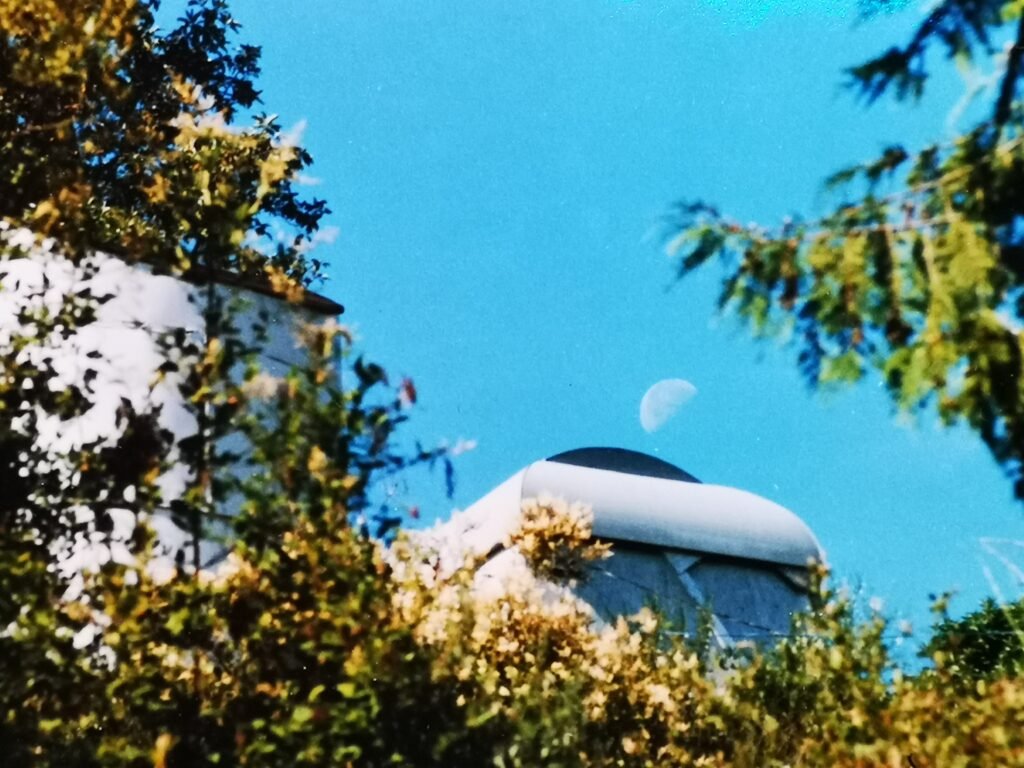
The above image was taken a year or so after our sighting. The white observatory (left side of the image) belonged to another obsessed sky watcher named Jack Newton.
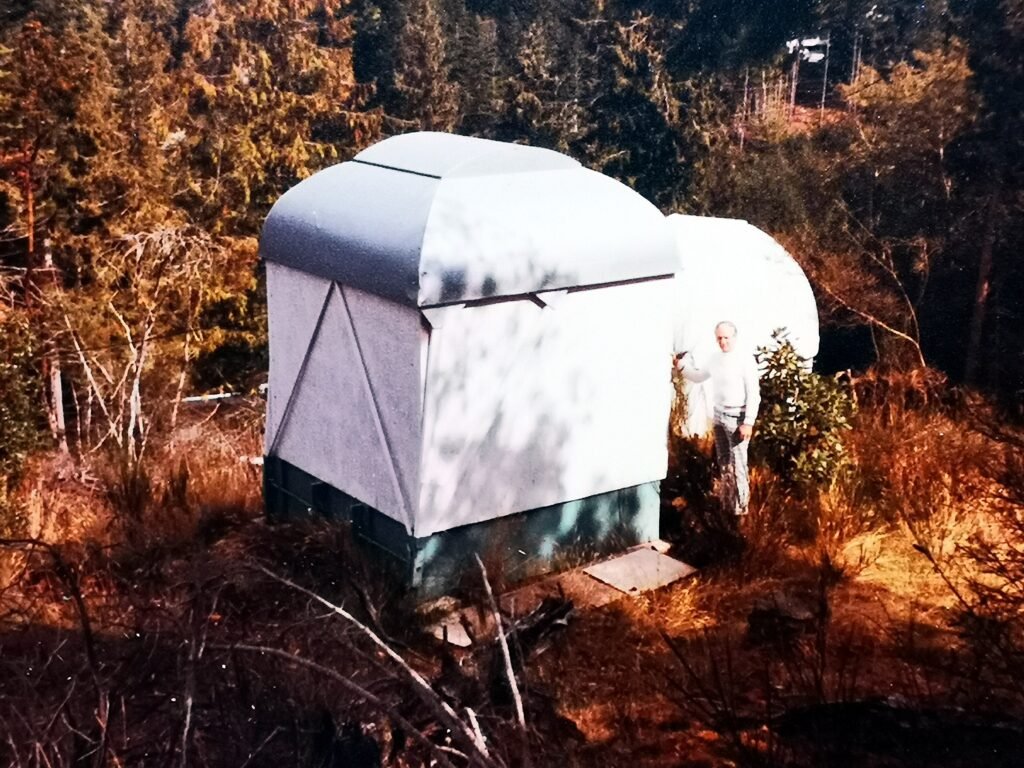
Dad Standing by the door for the observatory.
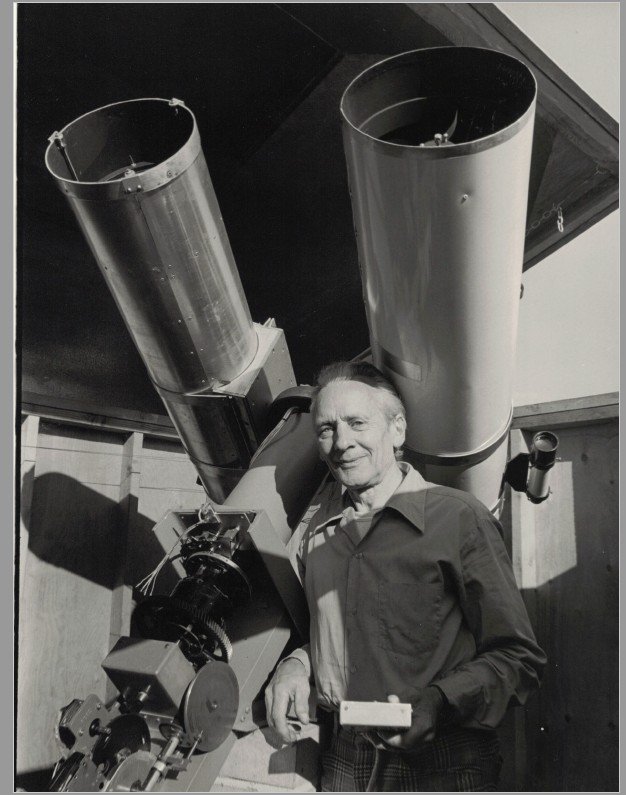
The above Image is my father, Leo VanderByl Sr., inside his new observatory.
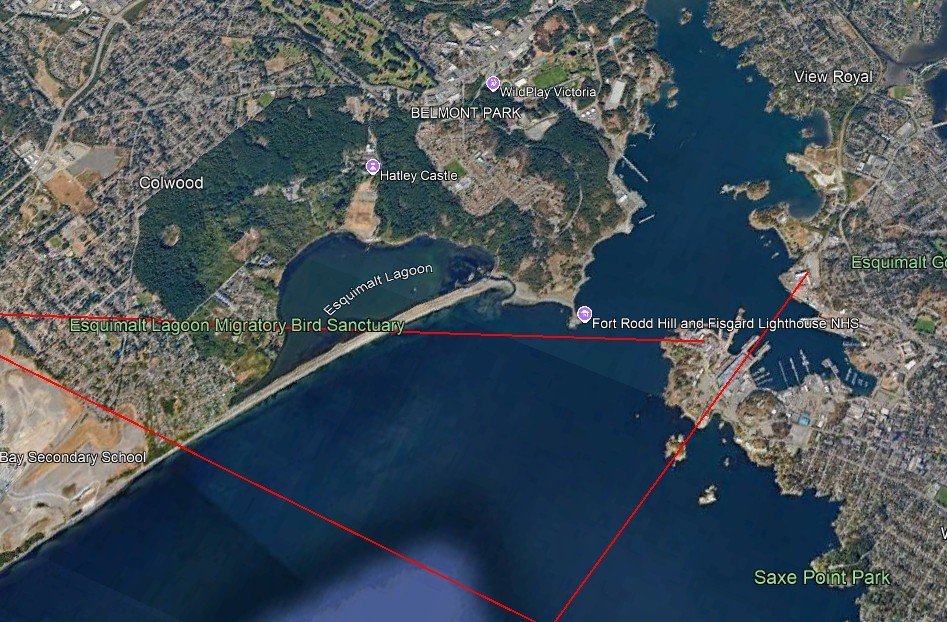
Google Earth Image 2026
Searching for a Habitable Planet
Our focus turned to the stars—and the problem of light pollution. Stars like our own are often obscured by the overwhelming brightness of larger neighboring stars. Given the sheer density of the night sky, identifying a suitable candidate becomes exponentially more difficult.
Finding a planet capable of supporting life means locating one in the “Goldilocks Zone”—the habitable band around a star where liquid water can exist. But consider a star system like Mintaka, which is roughly 190,000 times brighter than our Sun. Finding an Earth-sized planet near a star like that is like trying to spot a firefly next to a stadium floodlight.
My father once traveled to the small town of Osoyoos in the South Okanagan, B.C. There, away from the heavy nighttime light pollution of Victoria, the night sky was awash with countless stars. Yet, back in 1979, using line-of-sight methodology to isolate a habitable zone around a distant star was virtually impossible.